Carbon Neutral Event Certification & ISO 20121 Audits
Third-Party GHG Audits & Scope 3 Decarbonisation for AGMs, Summits, and Corporate Expos
Large-scale corporate summits, annual general meetings (AGMs), and expos carry a heavy, hidden carbon footprint. Under the GHG Protocol, your event’s venue energy, delegate travel, catering, and supply chain waste directly impact your Scope 3 (Categories 1, 5, and 6) emissions.
NCMA India moves your enterprise beyond generic offsetting to deliver audit-ready event decarbonisation:
- ISO 20121 & GHG Accounting: Complete Event lifecycle emissions measurement strictly mapped to ISO 14064-3 (Category 1, 5 & 6) and ISO 20121 standards.
- Audit-Ready Compliance: Transparent verification documentation tailored for corporate ESG reporting and SEBI BRSR disclosures.
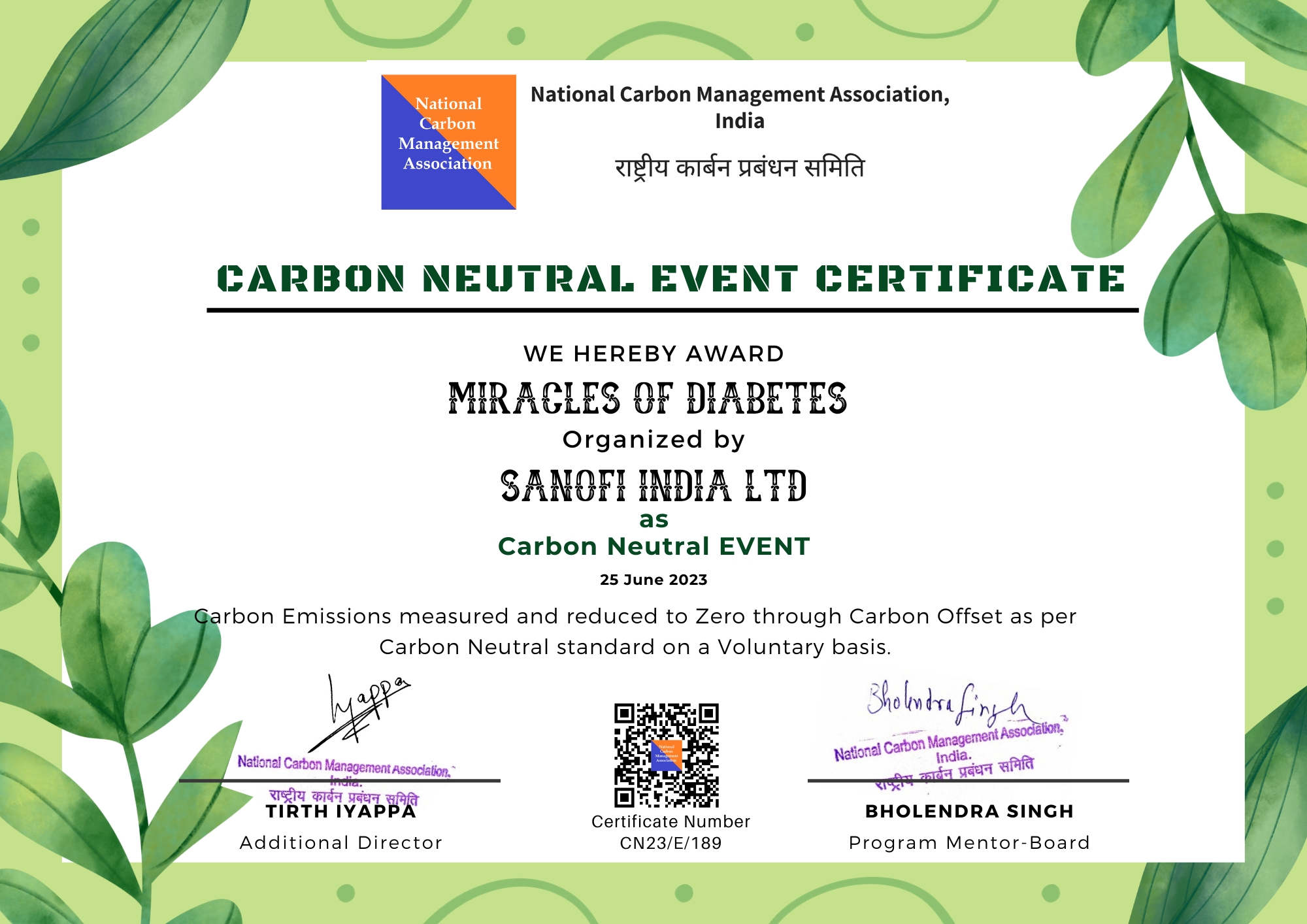
- Public Registry Verification: Receive an official NCMA Carbon Neutral Event Certificate backed by our searchable national database.
Eliminate greenwashing risks, satisfy corporate supply chain mandates, and protect your ESG ratings with India’s leading sustainability audit body.
Why India’s Top Corporates Trust NCMA Event Audits
From public sector giants to elite educational institutes, India’s top leaders trust NCMA’s auditing frameworks:
Government Recognized
Appointed Ministry of MSME Domain Expert (2026)
Military-Grade Trust
MoU-backed Sustainability partner to the Indian Army (IMA, Dehradun).
NITI Aayog Registered
National Carbon Management Association is officially registered with NITI Aayog, Government of India (Unique ID: DL/2018/0182207).
Elite Client Network
Frameworks trusted by RBI, L&T, IITs, SBI, Indian Army, NTPC, Cromption, Sanofi and many more.
ISO 20121 Framework
ISO 20121 Sustainable Event Management System Audits
Audit-Ready Scope 3 Value Chain Tracking
Under the international GHG Protocol Standard, your corporate events directly impact your annual sustainability compliance disclosures. We meticulously calculate and neutralize emissions across three critical corporate cost categories:
Category 6: Business Travel & Lodging:
Complete tracking of flights, rail transit, local travel, and hotel stays for all event delegates and internal teams.
Category 1: Purchased Goods & Services (Energy & Food):
Footprint mapping of venue energy usage, stage setups, catering footprints, and third-party event vendor supplies.
Category 5: Operational Waste Minimization:
Quantifying and offsetting the environmental impact of single-use event materials, plastics, branding boards, and discarded food.
Our End-to-End Certification Framework
Step 1: Predictive Mapping:
We audit your initial event logistics, venue size, and attendee projections to establish a baseline emissions forecast.
Step 2: On-Site Tracking:
We quantify actual utility consumption, travel logs, food management data, and material usage during the realization of the event.
Step 3: Verified Mitigation & Offsetting:
Residual, unavoidable emissions are entirely counteracted with equivalent, fully tracked carbon credits under recognized international protocols.
Step 4: Central Database Certification:
Your organization is awarded an official NCMA Carbon Neutral Event Certificate, complete with a unique ID searchable live on our central tracking database for absolute transparency.
Frequently Asked Questions: ISO 20121 & Event Carbon Audits
What is ISO 20121 Certification, and why is it necessary for corporate events?
ISO 20121 is the international management system standard for event sustainability. It provides a formal framework to manage, measure, and minimize the environmental, social, and economic impacts of events. For corporate AGMs, summits, and expos, achieving ISO 20121 alignment proves to stakeholders, auditors, and investors that your organization operates under globally recognized sustainability controls rather than unverified self-claims.
How does NCMA issue a Carbon Neutral Event Certificate?
NCMA follows a rigorous 3-step audit process:
Pre-Event Accounting: Quantifying baseline operational emissions using ISO 20121, ISO 14064-3 & GHG Protocol frameworks.
On-Site Verification: Auditing venue energy use, waste streams, and supply chain activities during the event.
Event Reconciliation & Registry: Verifying residual emissions, confirming high-integrity offsets or Carbon Credits under ISO 14068, and publishing your official certificate to our searchable National Verification Registry.
What is the typical audit timeline for certifying a corporate summit or AGM?
Timeline expectations depend on event scale:
| Event Scale | Onboarding & Pre-Audit | On-Site Verification | Final Audit Report & Certificate |
|---|---|---|---|
| Regional Summits / AGMs | 1 – 2 Weeks prior | Event Day(s) | 5 – 7 Business Days post-event |
| Large-Scale Expos / Trade Shows | 3 – 4 Weeks prior | Event Day(s) | 10 – 14 Business Days post-event |
Note: For urgent or fast-track corporate AGMs, NCMA offers accelerated audit protocols upon request.
What data and documents does our team need to provide for the audit?
Your dedicated NCMA auditor will assist in collecting:
Venue energy logs and utility billing estimates.
Delegate travel data (flights, local transport modal split, hotel stay nights).
Catering supply manifests (food/beverage packaging, organic waste output).
Event production material specs (flex/banners, staging, booth construction materials).
Which GHG Protocol Scope 3 Categories are covered in an event carbon audit?
NCMA’s event GHG accounting directly captures the primary emissions drivers across three core Scope 3 Categories:
Category 1 (Purchased Goods & Services): Staging, printing, catering, merchandise, and vendor services.
Category 5 (Waste Generated in Operations): Food waste, single-use materials, and booth breakdown disposal.
Category 6 (Business Travel & Delegate Commute): Airfare, rail, local transit, and hotel accommodation for speakers, attendees, and staff.
Can NCMA event audit reports be used for SEBI BRSR and international ESG disclosures?
Yes. All NCMA audit deliverables are compiled strictly under ISO 20121 & ISO 14064-3 third-party verification standards. The resulting GHG inventory report provides audit-ready data points formatted for seamless integration into SEBI BRSR (Business Responsibility and Sustainability Reporting) disclosures, GRI frameworks, and corporate ESG reports.
How do third parties or regulators verify our Carbon Neutral Certificate?
Every certificate issued by NCMA carries a unique Registry Verification ID (QR Code). Stakeholders, auditors, or media can scan the code to view the certification validity in real time.
How do I get involved with NCMA?
Getting involved with NCMA India is designed to be straightforward and actionable depending on whether you operate within the event supply chain or represent an industry body:
For the Event Sector (Organizers, Venues, Agencies & Suppliers):
Initiate a Baseline Assessment: Connect with NCMA to evaluate your current event operations, supplier onboarding policies, and venue waste streams against ISO 20121 standards.
Access Verification Toolkits: Leverage our pre-event data templates to measure baseline emissions across Scope 3 Categories 1, 5, and 6.
Achieve Carbon Neutral Certification: Undergo live on-site auditing during event execution to verify reduction measures and receive your third-party ISO 14068-1 certificate.
For Industry Associations & Trade Bodies (Chambers, Alliances & Councils):
Co-Develop Sector Playbooks: Partner with NCMA to roll out standardized event decarbonization guidelines and ESG vendor checklists across your entire member network.
Host Capacity-Building Workshops: Conduct accredited training sessions for member organizations on Scope 3 accounting and SEBI BRSR compliance.
Deploy Group Certification Models: Establish umbrella frameworks that allow multi-vendor expos, industry trade shows, and annual summits to achieve bulk ISO 20121 alignment efficiently.